Ask ChatGPT and Gemini the same question about your brand and you can get two different answers not because one is wrong, but because each model synthesizes different evidence into a different tone.
- ChatGPT might call you “a trusted industry leader”
- Gemini might open with a caveat about pricing
- Both can be technically accurate only one is doing your brand favors
Why it matters now: Gartner projects generative AI will shape roughly 30% of brand perception by 2026 a meaningful share of how people form an opinion of your company now happens inside a model’s synthesis, before anyone reaches your website.
What Is Sentiment in AI Answers?
Sentiment describes the overall tone an AI assistant uses when discussing your brand not just whether you’re mentioned, but how.
- Responses can be positive, negative, neutral, or a mix of strengths and limitations
- Sentiment reflects the AI’s overall framing across multiple synthesized sources not the opinion of any single webpage
- Two brands can appear in the same answer with very different framing: one “a trusted industry leader,” the other flagged for pricing or reliability concerns
- Measuring sentiment tells you the quality of your AI visibility, not just the quantity
Context: Gartner also projects traditional search query volume could fall ~25% as AI chat and virtual agents absorb more search behavior turning AI perception from a side metric into a real budgeting line item.
How AI Sentiment Differs from Traditional Sentiment Analysis
| Comparison | Traditional Sentiment Analysis | AI Answer Sentiment |
|---|---|---|
| What It Measures | Opinions written by people (reviews, social posts, news). | Tone generated by an AI after retrieving and synthesizing sources. |
| Scale | Thousands to millions of documents. | One generated response per prompt. |
| Consistency | Relatively stable for each document. | Can vary by prompt, AI model, and retrieved sources. |
| What It Represents | A direct reflection of public opinion. | An output metric showing how AI currently presents your brand. |
Key takeaway: Because AI sentiment is an output, not a direct measure of opinion, repeated measurement across prompts and platforms matters more than any single response.
What sentiment actually measures
- Positive -emphasizes comprehensive features, strong support, few drawbacks
- Mixed – powerful functionality and a steep learning curve or higher pricing
- Neutral -a factual list of products/services with no evaluation
- Sentiment ≠ confidence or recommendation an AI can confidently note real drawbacks and still be balanced and trustworthy
- A few limitations mentioned doesn’t automatically mean negative sentiment
Why Sentiment Complements Citation Rate and Share of Voice
- Citation Rate / Share of Voice → how often you’re mentioned
- Sentiment → how those mentions are framed
- A high Citation Rate can still come with cautious framing (pricing, complaints, limited features)
- A brand mentioned less often can still build trust if its mentions are consistently positive
Engine gap example:
- Claude mentions brands in ~97% of relevant responses
- ChatGPT mentions brands in ~74% of relevant responses
- Tracking only one platform can make a brand look far more, or less, visible than it actually is
Full picture = four metrics together:
| Metric | Question It Answers |
|---|---|
| Citation Rate | Are you being cited? |
| Share of Voice | How often does your brand appear compared with competitors? |
| Citation Position | Where does your brand appear within the AI-generated answer? |
| Sentiment | How is your brand described by AI? |
Best practice: Never treat one AI response or one reporting export as the complete picture. Measure sentiment across multiple prompts, platforms, and repeated runs to find real trends.
How Is Sentiment Measured Across AI Engines?
- No universal sentiment score exists across ChatGPT, Gemini, Claude, Perplexity, etc.
- Each model generates a fresh response per prompt sentiment is measured from the final answer text, not the model’s internal reasoning
- Most AI visibility tools classify responses into: Positive / Mixed / Neutral / Negative
- Some platforms add numerical confidence scores these are interpretations of the text, not values the model outputs directly
How the process works, step by step
- The model interprets the question to understand intent
- It retrieves relevant information (web content, docs, reviews, etc.)
- It synthesizes that evidence into a natural-language answer
- Sentiment emerges during synthesis:
- Strong praise from authoritative sources → more positive tone
- Balanced reviews, limitations, conflicting opinions → mixed tone
- Little evaluative information available → neutral, factual tone
Platform behavior differs too -one analysis found ChatGPT behaves more like a product advisor, more willing to raise concerns on “is it worth it” queries than some other assistants. Same brand, same prompt, different engine → different framing.
The four sentiment categories
| Sentiment | What It Typically Means |
|---|---|
| Positive | Strengths, credibility, quality, and leadership are emphasized, with few significant drawbacks. |
| Mixed | Both advantages and limitations are presented, creating a balanced assessment rather than a negative one. |
| Neutral | Primarily factual information is provided without expressing a favorable or unfavorable opinion. |
| Negative | Weaknesses, risks, complaints, or significant limitations dominate the AI-generated answer. |
- Mixed is the most misunderstood category – it usually signals objective summarization, not poor performance
- For established, broadly-covered brands, mixed sentiment is often the realistic, healthy outcome
Why the same brand scores differently across engines
- Different retrieval systems – each engine pulls from different sources
- Different ranking algorithms – evidence selection varies by platform
- Different summarization styles – some models default to balance, others to caveats
- Prompt interpretation – small wording differences shift what gets emphasized
- Model updates -retrieval and language models improve continuously, shifting sentiment gradually
Best practice: Treat every sentiment score as a sample, not a permanent truth. Measure repeatedly across prompts, engines, and time periods.
Why Does AI Sentiment Change Over Time?
Four main drivers:
1. Retrieval is non-deterministic
- Identical prompts can pull slightly different evidence each time (different pages, reviews, docs)
- One run emphasizes innovation and satisfaction; another emphasizes pricing or implementation friction
- Both can be accurate they just summarize different slices of available evidence
2. Prompt wording shifts framing
- “What are the best AI visibility tools?” → highlights strengths, market leaders
- “What are the limitations of AI visibility tools?” → highlights drawbacks
- “Should small businesses buy AI visibility software?” → balances benefit vs. cost/complexity
- Same topic, three different sentiment outcomes – measure with a consistent, representative prompt set, not one question
3. New web evidence and model updates shift responses
- New launches, reviews, research, news, and documentation constantly change the evidence pool
- Providers regularly update retrieval and ranking, which reshapes how sources get weighted
- Same prompt asked months apart can produce a noticeably different answer, even with no real change on your end
4. Consumer AI usage is expanding fast
- Shopping-related generative AI usage grew ~35% between early and late 2025 (BCG)
- More people are forming brand impressions through AI summaries stale sentiment tracking becomes stale reputation management
Why one AI answer is never the whole truth
- A single response = one sample, from one model, one prompt, one moment, one retrieval set
- Reliable approach: measure across multiple engines → repeat each prompt several times → analyze the aggregate
- Consistent positive results across periods = confidence in the trend
- Wide run-to-run variance = you need more observations before concluding anything
Perception risk of skipping this: a March 2026 study found a 40-point gap between how positively marketers believe consumers perceive AI-generated content and how consumers actually feel internal assumptions can be badly miscalibrated without direct measurement.
Bottom line: a sentiment label is the start of analysis, not the conclusion. It tells you what the AI said, not why for that, you need the language and evidence behind the score.
Reading the Four Categories Correctly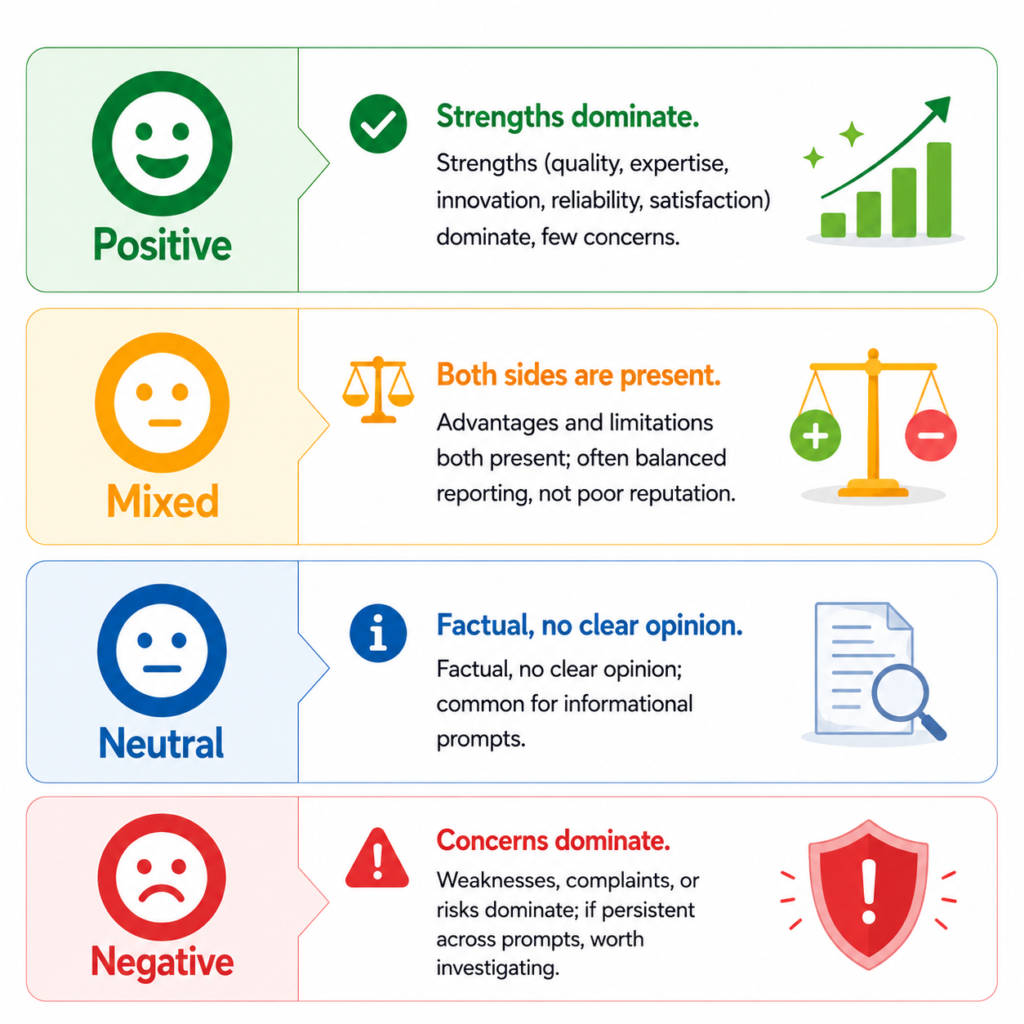
- Positive – strengths (quality, expertise, innovation, reliability, satisfaction) dominate, few concerns
- Mixed – advantages and limitations both present; often balanced reporting, not poor reputation
- Neutral – factual, no clear opinion; common for informational prompts
- Negative – weaknesses/complaints/risks dominate; if persistent across prompts, worth investigating
Sentiment ≠ closed sale: a May 2026 Gartner survey found 69% of B2B buyers still prefer to validate AI-generated insights with a human sales rep before deciding. Positive sentiment sets the stage it rarely closes the deal alone. Sentiment tracking should feed sales and content enablement, not just marketing reporting.
Look at recurring phrases, not just the label
A score tells you how you’re described; recurring phrases tell you why.
- Positive responses repeating “trusted,” “easy to use,” “well-documented,” “recommended for enterprises” → your consistent strengths
- Repeated “expensive,” “limited integrations,” “slow support,” “best for large businesses” → recurring concerns shaping perception, even inside an overall-positive score
Track phrases to answer:
- Which strengths appear most often?
- Which weaknesses are repeatedly mentioned?
- Are the same themes showing up across multiple engines?
- Are new concerns emerging after product or market changes?
Real scenarios of score and story
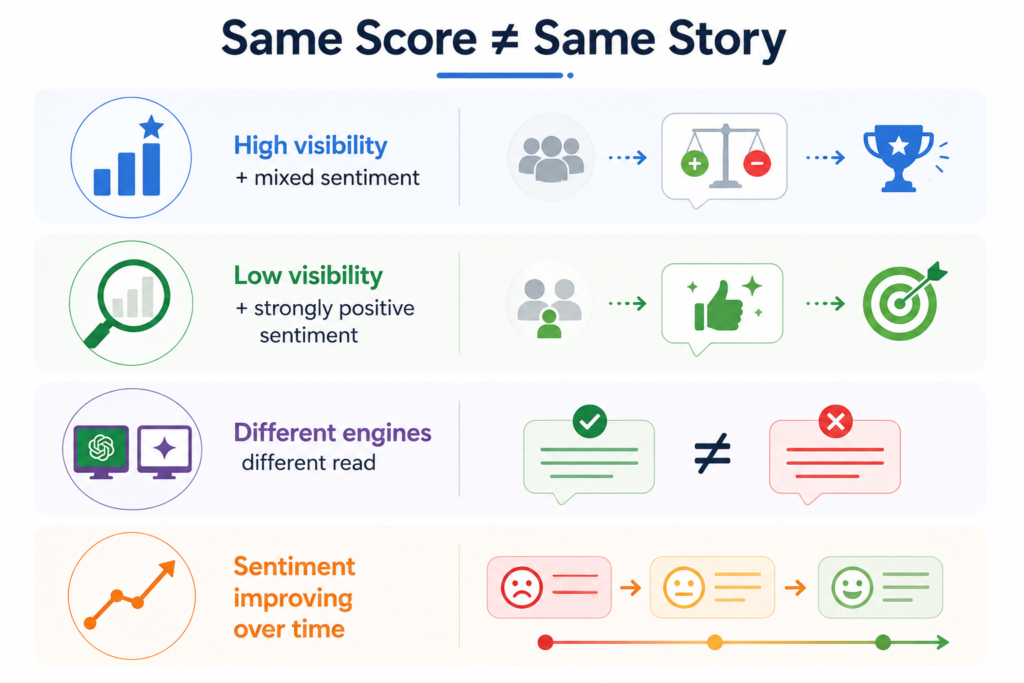
- High visibility + mixed sentiment – appears in nearly every category answer; strong features flagged alongside price/complexity. Still a leading solution -mixed here = balanced evaluation, not a problem.
- Low visibility + strongly positive sentiment – rarely mentioned, but described as innovative and easy to use when it is. The challenge is visibility, not perception.
- Different engines, different read -ChatGPT calls it reliable and all-around; another engine flags limited reporting and calls it mixed. Compare multiple runs before assuming either is “right.”
- Sentiment improving over time – better documentation, stronger reviews, and industry coverage gradually shift phrasing from “limited resources” to “well-documented platform” and “trusted by enterprise customers.”
Best practice: Always read sentiment alongside Citation Rate, Share of Voice, and Citation Position together.
How to Improve Your Brand’s Sentiment in AI Answers
Not about gaming a model sentiment improves when the public evidence about your brand gets stronger, more accurate, and more consistent.
1. Strengthen authoritative content and third-party mentions
- Publish documentation, case studies, original research, comparison guides, and FAQs that demonstrate expertise (not promotion)
- Earn mentions from industry publications, analysts, associations, and credible review sites
- Editorial coverage carries outsized weight models tend to treat independent editorial judgment as an authority signal, not a promotional claim
- A consistent presence across multiple authoritative sites beats relying on owned content alone
2. Improve reputation signals and address recurring concerns
- Identify recurring weaknesses mentioned across AI responses (support speed, integrations, docs, pricing)
- Check whether those concerns show up in reviews, community discussions, or press coverage
- Fix the underlying issue rather than trying to suppress the narrative:
- Improve the product/service itself
- Update documentation
- Respond professionally to feedback
- Publish transparent updates and measurable improvements
- Goal: a balanced, up-to-date picture not zero criticism
3. Track sentiment trends across prompts, engines, and time
- Use the same representative prompt set, repeated multiple times
- Measure across ChatGPT, Gemini, Claude, Perplexity, and other relevant platforms
- Record: overall sentiment category + recurring strengths + recurring concerns + frequently cited sources
- Compare weekly, monthly, and quarterly to separate real movement from normal AI variability
Best practice: You can’t control AI sentiment directly, but you can influence the evidence it’s built from authoritative content, third-party recognition, resolved customer concerns. Never treat one response or one export as the full picture.
FAQs
1. What’s the difference between AI sentiment and traditional brand sentiment analysis?
Traditional analysis measures what people say about a brand (reviews, social, news). AI sentiment measures what an AI assistant says in its generated answers an output shaped by retrieval and summarization, not a direct read of public opinion.
2. Why does the same brand get different sentiment scores from ChatGPT vs. Gemini or Claude?
Different retrieval systems, ranking algorithms, summarization styles, and prompt interpretation. Normal behavior, not an error track across platforms rather than picking one.
3. Is mixed sentiment a bad sign?
Usually not. It often reflects balanced, objective summarization common and expected for established brands with wide public coverage. Only a concern if the same specific weaknesses recur persistently.
4. How often should sentiment be measured?
Continuously weekly for operational monitoring, monthly for trend reporting using a consistent prompt set across multiple engines. One measurement is a sample, not a trend.
5. Can you directly control what AI assistants say about your brand?
No but you can shape the underlying evidence they retrieve and synthesize (authoritative content, third-party coverage, resolved concerns), which shifts sentiment indirectly over time.
Want to know where your brand stands in the citation economy?
We run a free 6-platform AI visibility audit during a 30-minute strategy call. No prep required — we'll scan your category live during the conversation.