AI visibility has quickly become an important marketing KPI. But executives rarely care about citations or mentions for their own sake. Marketing teams may celebrate appearing in ChatGPT, Perplexity, or other AI assistants yet finance and executive leadership ultimately ask a different question:
How does this contribute to revenue, pipeline, or business growth?
That shift in perspective matters. AI visibility is a leading indicator of future demand, not revenue itself. Understanding the difference is what allows marketing teams to build reporting that earns executive trust, rather than making claims the data can’t support.
Modern customer journeys are non-linear: buyers move across many channels and touchpoints before converting. That makes it misleading to attribute revenue to any single marketing interaction including AI visibility.
Why Citation Counts Alone Aren’t Enough for Executives
A citation means an AI system selected your brand or content as a source while generating an answer. It’s evidence that your content has become part of the AI retrieval ecosystem.
For SEO teams, rising citation counts are a meaningful success signal. For executives, citation counts only answer one question: “Did the AI mention us?”
They don’t answer:
- Did more potential buyers discover the brand?
- Did branded search volume increase?
- Did website engagement improve?
- Did more qualified leads enter the sales pipeline?
- Did revenue change?
A company could double its AI citations while generating little commercial impact, if those citations appear mostly for low-intent, informational prompts. Conversely, a small increase in citations for high-commercial-intent queries may influence far more qualified prospects.
This is why reporting citation totals alone creates a disconnect between marketing and leadership. AI visibility metrics should be positioned as leading indicators that influence later business outcomes — not as business outcomes themselves.
The CFO’s Question: “How Does AI Visibility Affect Pipeline?”
Finance and executive teams evaluate marketing investment differently than marketing practitioners do. Instead of asking “how many AI mentions did we receive?”, they ask:
- Did marketing generate more qualified opportunities?
- Did pipeline improve?
- Did customer acquisition become more efficient?
- Did revenue increase?
Those questions require a business framework, not a visibility report. A useful way to explain AI’s role is as a chain of influence:
AI Citation → Brand Discovery → Branded Search → Website Visit → Lead → Opportunity → Revenue
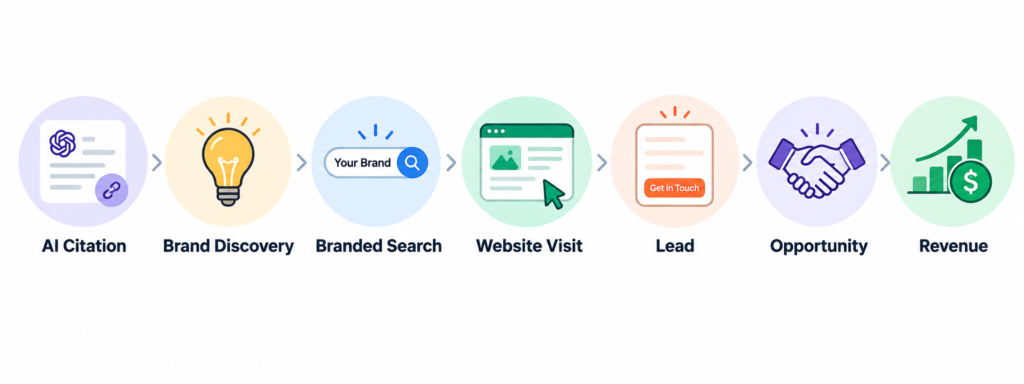 Each stage increases the probability of business impact — but none guarantees the next stage. For example:
- A procurement manager asks ChatGPT for the best enterprise analytics platforms.
- ChatGPT cites your company.
- The buyer later searches your brand on Google.
- They visit your website and download a buyer’s guide.
- Sales qualifies the lead.
- Months later, the opportunity closes.
The AI citation contributed to this journey, but it was one touchpoint among many organic search, paid campaigns, referrals, webinars, sales outreach, and product demos all played a role. Gartner research indicates B2B buying groups spend only a small share of their purchase journey interacting directly with suppliers, and spend much more time on independent digital research a phase AI assistants are increasingly part of.
That’s why responsible reporting describes AI visibility as pipeline influence, not automatic pipeline generation.
The AI Visibility-to-Revenue Framework
Connecting AI visibility to revenue means following the customer journey rather than searching for a single cause-and-effect relationship:
AI Citation → Branded Search Lift → Brand Engagement → Assisted Conversions → Qualified Pipeline
Step 1 – AI Citations Create Brand Exposure During Research
When ChatGPT, Google AI Mode, Microsoft Copilot, Perplexity, or similar assistants mention your company while answering a question, your brand enters the buyer’s research process — often for the first time. Someone searching “best project management software for remote teams” may see your product listed alongside established competitors. Even without an immediate click-through, your brand has entered the consideration set. At this stage, the value is awareness, not instant revenue.
Step 2 – Increased Visibility Drives Branded Search Demand
After discovering a company via an AI assistant, many users perform a branded search rather than clicking straight from the AI answer searching the company name, reading reviews, comparing competitors, or checking pricing. This makes branded search volume one of the strongest downstream signals that AI visibility is generating interest. If citation rates rise consistently over several months alongside branded search volume, that correlation is a meaningful directional signal — even though it doesn’t prove direct causation.
Step 3 – Brand Engagement Leads to Assisted Conversions
Awareness alone doesn’t create pipeline; prospects need to engage. After reaching your site, users may download a guide, register for a webinar, request a demo, subscribe to a newsletter, contact sales, or start a free trial.
These are assisted conversions AI may have driven the initial discovery, while other channels moved the prospect toward conversion. Google’s Zero Moment of Truth (ZMOT) research points to buyers consulting multiple digital sources before purchasing; AI assistants are increasingly one of those early research touchpoints, not the final conversion source.
Step 4 – Assisted Conversions Influence Qualified Pipeline
As prospects progress, some become marketing-qualified leads, sales-qualified leads, opportunities, and eventually customers. AI visibility becomes one of several contributing factors not the sole cause. This is why pipeline reporting should focus on influenced pipeline, not “AI-generated pipeline.”
A Contribution Model, Not a Direct Attribution Model
One of the biggest mistakes organizations make is trying to prove a specific AI citation caused a specific closed deal. Today’s analytics tools can’t reliably make that connection buyers move across devices, browsers, search engines, AI assistants, email, and social platforms throughout the purchase process, and AI assistants generally don’t pass referral data the way websites do.
Because of this, AI visibility should be reported as a contributing marketing channel similar to brand awareness campaigns, PR, or organic search. A responsible executive summary might read:
“AI visibility increased 32% during the quarter. During the same period, branded search demand, demo requests, and influenced pipeline also grew. While direct attribution cannot be confirmed, the combined evidence suggests AI visibility is contributing positively to buyer discovery and pipeline development.”
This is both transparent and credible: it acknowledges the current limits of attribution while still demonstrating measurable business relevance.
What to Measure at Each Stage
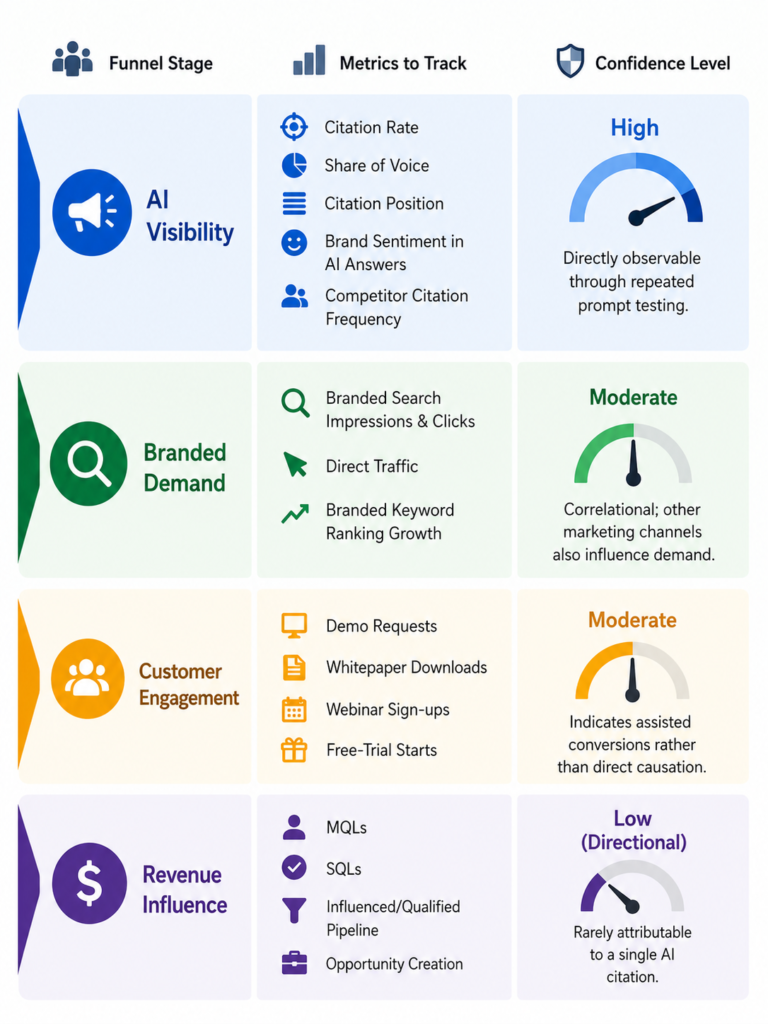 Confidence generally decreases the further down the funnel you look. Citation data can be measured with high confidence; revenue causation cannot yet be proven.
| Funnel Stage | Metrics to Track | Confidence Level |
|---|---|---|
| AI Visibility | Citation Rate, Share of Voice, Citation Position, Brand Sentiment in AI Answers, Competitor Citation Frequency | High -Directly observable through repeated prompt testing. |
| Branded Demand | Branded Search Impressions & Clicks, Direct Traffic, Branded Keyword Ranking Growth | Moderate -Correlational; other marketing channels also influence demand. |
| Customer Engagement | Demo Requests, Whitepaper Downloads, Webinar Sign-ups, Free-Trial Starts | Moderate- Indicates assisted conversions rather than direct causation. |
| Revenue Influence | MQLs, SQLs, Influenced/Qualified Pipeline, Opportunity Creation | Low (Directional) -Rarely attributable to a single AI citation. |
Because large language models are probabilistic, a single prompt result means little. The same prompts should be tested repeatedly across ChatGPT, Google AI Mode, Microsoft Copilot, and Perplexity using a consistent prompt library, then tracked as a trend over weekly or monthly periods. For example, a Citation Rate moving from 12% to 24% across the same commercial prompt set over three months is a meaningful improvement worth reporting.
Microsoft’s guidance on Retrieval-Augmented Generation (RAG) notes that AI systems draw on retrieved content that changes over time, so identical prompts can return different answers another reason repeated measurement, not one-off snapshots, is essential.
Common Reporting Mistakes That Overstate AI’s Business Impact
- Treating every AI citation as a qualified lead
- Reporting citation growth without measuring downstream engagement
- Assuming branded search growth was caused only by AI visibility
- Crediting closed revenue directly to AI mentions without supporting evidence
- Measuring only one AI platform while ignoring others
- Drawing conclusions from a single prompt instead of repeated testing
These practices can produce impressive-looking dashboards, but they erode credibility the moment an executive asks for supporting evidence. AI visibility should instead be presented as one component of a broader demand-generation strategy that includes SEO, content marketing, paid media, email, and sales outreach.
Communicating Uncertainty Without Losing Executive Trust
Executives tend to trust reports that clearly separate measured facts from reasonable interpretation acknowledging uncertainty actually strengthens credibility rather than weakening it.
Measured with confidence:
- AI Citation Rate increased from 18% to 31%
- Share of Voice improved across commercial prompts
- Branded search impressions increased by 24%
- Demo requests increased by 15%
Directional interpretation:
- AI visibility likely contributed to increased brand discovery
- Growth in branded search suggests more users researched the company after AI exposure
- AI visibility appears to be supporting pipeline creation alongside other marketing channels
Building an Executive Reporting Framework
Executive reporting should answer one question above all: “Is improving AI visibility creating measurable business value?” That answer is rarely found in a single metric it comes from combining AI visibility data with search performance, engagement, CRM, and pipeline reporting.
Combine four data sources
| Data Source | Example Metrics | Business Question Answered |
|---|---|---|
| AI Visibility | Citation Rate, Share of Voice, Citation Position, Sentiment | Are AI platforms recommending our brand more often? |
| Search Performance | Branded Search Impressions & Clicks, Organic Traffic | Are more people actively looking for our company? |
| CRM & Marketing | Demo Requests, MQLs, SQLs, Assisted Conversions | Is increased awareness creating qualified opportunities? |
| Revenue Metrics | Pipeline Value, Opportunity Creation, Closed Revenue | Is marketing contributing to measurable business growth? |
Separate leading indicators from lagging outcomes
Leading indicators (predict future performance): Citation Rate, Share of Voice, Citation Position, brand sentiment, branded search demand, website engagement.
Lagging indicators (confirm results after the fact): MQLs, SQLs, pipeline value, opportunities created, closed revenue, customer acquisition.
The Balanced Scorecard Institute recommends combining both types for exactly this reason leading metrics forecast, lagging metrics confirm. Keeping the two groups visually and conceptually separate in a report prevents the impression that AI visibility produces revenue immediately; in practice, improvements in leading indicators often precede business outcomes by weeks or months, depending on the industry’s buying cycle.
Report on a monthly and quarterly cadence
Monthly dashboard:
- AI Citation Rate
- Share of Voice
- Top cited competitors
- Branded search growth
- Demo requests and assisted conversions
Quarterly executive report:
- Quarter-over-quarter AI visibility trends
- Changes in branded demand
- Marketing-influenced pipeline and opportunity growth
- Executive summary of key business insights
Quarterly reporting is especially valuable because AI visibility tends to shift gradually as content gets indexed, retrieval systems update, and brand authority builds over time so dashboards should emphasize sustained trends across a consistent prompt set, rather than individual prompt results.
Want to know where your brand stands in the citation economy?
We run a free 6-platform AI visibility audit during a 30-minute strategy call. No prep required — we'll scan your category live during the conversation.