Many teams look for a single AI visibility score that summarizes how well their brand performs across ChatGPT, Gemini, Microsoft Copilot, Perplexity, and other AI assistants. It’s a tempting idea but a single score usually hides the exact information that explains why you’re performing the way you are.
Why one number breaks down:
- AI-generated answers are dynamic the same prompt can produce different responses over time
- Every AI engine uses its own retrieval methods, ranking signals, and citation behavior
- A brand can be highly visible on one platform and almost absent on another
- Collapsing all of that into one number makes it nearly impossible to spot strengths, weaknesses, or real opportunities
The fix: evaluate multiple metrics together. That’s the only way to see how often AI systems recommend your brand, where it appears, and how it’s presented to users.
Key takeaways
- No single AI visibility metric tells the complete story each one answers a different business question
- The four canonical metrics are Citation Rate, Share of Voice, Citation Position, and Sentiment
- Averaging results across AI engines can hide serious visibility gaps always measure ChatGPT, Gemini, Copilot, and Perplexity separately before combining insights
- Two brands can share the same Citation Rate and still have completely different real-world influence
Why One Metric Never Tells the Complete Story
Every AI visibility metric answers a different question. Looking at only one creates an incomplete picture:
- High Citation Rate, buried placement -a brand mentioned frequently, but near the bottom of long responses, is less likely to get noticed
- Great position, low frequency -a brand that’s always first when mentioned, but only shows up in a small share of relevant prompts, has excellent placement and limited discoverability
- Frequent citations, weak reputation – a brand cited often but consistently flagged for pricing or implementation issues has visibility without a strong reputation
Bottom line: because each metric measures a different dimension of AI performance, no single metric can represent overall visibility on its own.
The 4 Metrics That Define AI Visibility
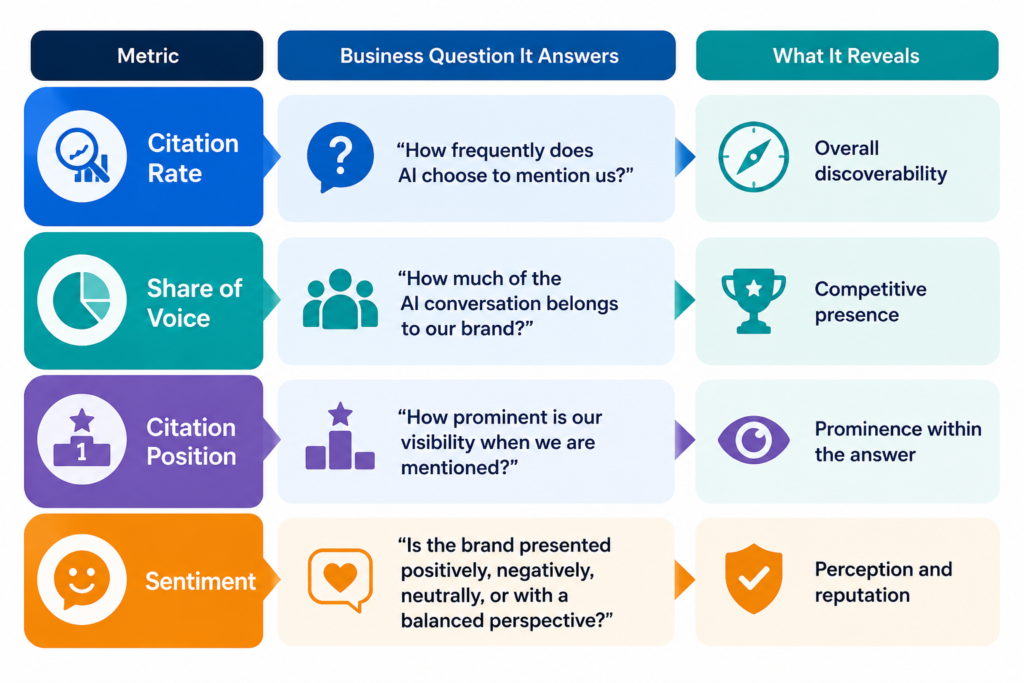
Citation Rate: How Often AI Chooses Your Brand
Citation Rate measures how often AI assistants mention your brand when responding to relevant prompts. Every time someone asks ChatGPT, Gemini, Copilot, or Perplexity an industry-related question, the AI decides which brands to include Citation Rate quantifies how often yours makes the cut.
Example: if your brand appears in 45 out of 100 relevant prompts, your Citation Rate is 45%.
What it tells you
- How frequently AI assistants recommend or reference your brand
- How your visibility compares to competitors on the same prompt set
- Whether SEO, PR, or content initiatives are moving the needle
- Which categories or topics your brand is consistently recognized in
- Long-term visibility trends across different AI platforms
What it doesn’t tell you
- Where your brand appears within a response
- Whether AI presents your brand positively, negatively, or neutrally
- How often competitors are mentioned alongside you
- Whether users are likely to notice or act on the mention
Why it can’t stand alone: two brands can both post a 40% Citation Rate one consistently as the first, positively-described recommendation, the other buried near the end with mixed sentiment. Same number, very different real-world visibility.
Share of Voice: How Much of the Conversation You Own
While Citation Rate measures how often you appear, Share of Voice (SoV) measures how much of the AI conversation belongs to you relative to competitors.
Example: AI mentions five project management brands across 100 prompts, generating 400 total brand mentions. If your brand accounts for 120 of them, your Share of Voice is 30%.
What it tells you
- How much of the AI conversation your brand owns
- Which competitors are outpacing you
- Whether your visibility is trending up or down
- Whether you’re becoming a category leader in AI search
What it doesn’t tell you
- Where your brand appears within a response
- Whether the mentions are positive or negative
- Your standalone frequency independent of competitors
- Whether users are more likely to notice you than a rival
Why it can’t stand alone: you could have the highest Share of Voice in your category and still lose influence if those mentions consistently land at the bottom of long answers or come with negative commentary attached.
Citation Position & Sentiment: Visibility Alone Isn’t Enough
Being mentioned is only half the picture. To understand real impact, you also need to know where your brand appears and how it’s described.
Citation Position – where you appear
AI assistants often recommend multiple brands in one answer, but users pay the most attention to the first few. A brand that’s consistently first or second has stronger effective visibility than one that’s usually fifth or sixth even with an identical Citation Rate.
| Tells You | Doesn’t Tell You |
|---|---|
| How prominent your brand is when selected | How often your brand is mentioned overall |
| Whether your ranking is improving or declining over time | Whether the description is positive or negative |
| How your placement compares with competitors | How much of the overall AI conversation your brand owns |
| Whether AI treats your brand as a leading recommendation | Overall brand sentiment and perception |
Sentiment – how you’re described
Sentiment evaluates the overall tone AI uses about your brand: positive, neutral, mixed, or negative.
- “Easy to use, reliable, highly recommended” → positive
- “Powerful but expensive and difficult to implement” → mixed
| Tells You | Doesn’t Tell You |
|---|---|
| How AI presents your brand over time | How often your brand appears |
| Recurring strengths and weaknesses in the AI narrative | Where your brand is positioned within the answer |
| How your brand perception compares with competitors | Whether your brand is the most frequently cited |
| Whether content, PR, or reputation efforts are improving AI perception | Overall visibility across AI platforms |
Why position and sentiment must be read together
- First position + positive sentiment → strongest possible impact
- First position + mixed/negative sentiment → visibility without trust
- Excellent sentiment + bottom-of-answer placement → favorable but under-leveraged
Combined with Citation Rate and Share of Voice, Position and Sentiment complete the picture: how often you’re mentioned, how prominently, how you compare to competitors, and how users are likely to perceive you.
How the Four Metrics Interact: Real Scenarios
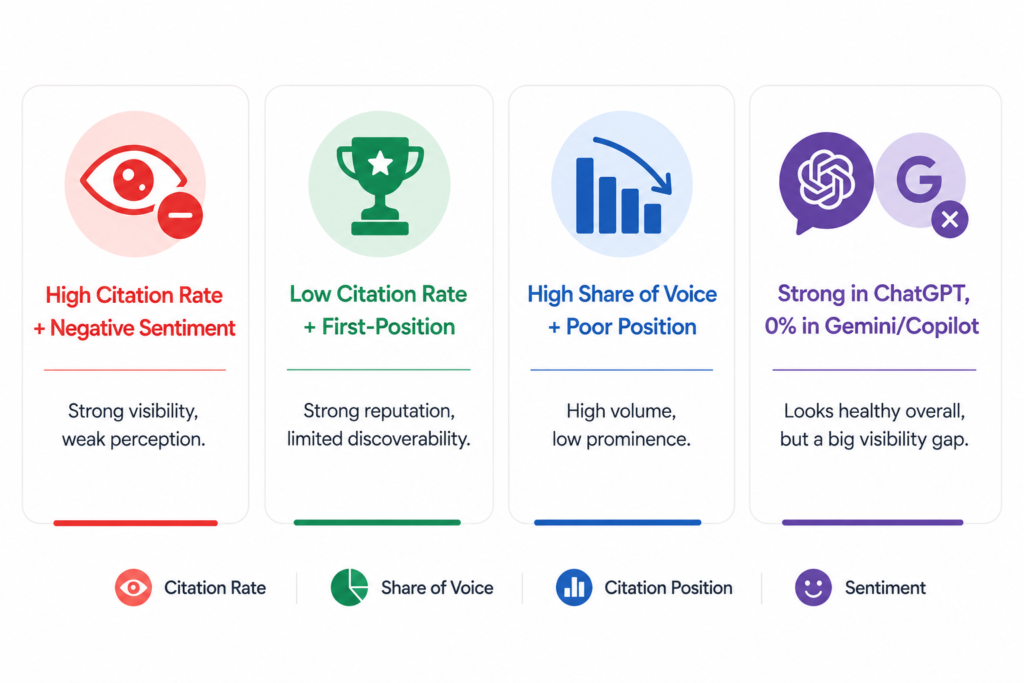
| Scenario | What It Actually Means |
|---|---|
| High Citation Rate + Negative Sentiment | Strong visibility, weak perception. Your brand is mentioned frequently, but AI responses consistently highlight pricing, customer support, or product limitations. |
| Low Citation Rate + First-Position Mentions | Strong reputation, limited discoverability. When AI mentions your brand, it ranks it highly, but it appears in only a small percentage of relevant prompts. |
| High Share of Voice + Poor Citation Position | Your brand dominates overall mention volume but is usually listed near the end of AI responses, reducing its visibility to users. |
| Strong in ChatGPT, 0% Visibility in Gemini/Copilot | Overall reports may look healthy, but an entire audience segment never sees your brand. Only engine-level reporting exposes this visibility gap. |
Takeaway: every one of these scenarios looks identical if you only track one metric or an averaged score. The differences only surface when all four are read together.
Never Average Across AI Engines – Measure Each One Separately
Each AI engine retrieves and ranks information differently, so performance can vary dramatically by platform.
- Averaging Citation Rate across ChatGPT, Gemini, Copilot, and Perplexity can produce a healthy-looking overall number while hiding a serious gap
- Example: a 40% overall Citation Rate could be masking 70% visibility on ChatGPT and 0% on Gemini an entire audience segment seeing nothing
The fix: treat every engine as its own search environment
- Record all four metrics per engine, using the same prompt set and reporting period
- This lets you:
- Identify where your brand is strongest
- Find engines where visibility needs work
- Compare performance consistently over time
- Prioritize optimization based on real data, not blended averages
- Only after understanding engine-level performance should you combine insights into an overall visibility view
Building an Analyst-Grade AI Visibility Dashboard
A reliable dashboard should:
- Report Citation Rate, Share of Voice, Citation Position, and Sentiment for every AI engine separately
- Track changes over time weekly, monthly, or quarterly
- Compare results against key competitors on the same prompt set
- Only then roll up engine-level data into overall trend reporting
Monitoring all four metrics together rather than relying on a single score or a blended average moves your reporting past simple visibility counts and into a complete view of how often AI recommends your brand, how prominently, how you stack up against competitors, and how users are likely to perceive you.
FAQ
1. Why isn’t a single AI visibility score enough?
Because it collapses four different signals frequency, competitive share, prominence, and perception into one number, hiding exactly the detail you’d need to know what to fix.
2. Which metric matters most: Citation Rate or Share of Voice?
Neither on its own. Citation Rate shows standalone discoverability; Share of Voice shows competitive presence. A brand can look strong on one and weak on the other track both.
3. Can a brand have a high Citation Rate but still perform poorly in AI search?
Yes. If those citations land near the bottom of responses or carry negative or mixed sentiment, high frequency doesn’t translate into influence.
4. Why shouldn’t I average my visibility metrics across AI engines?
Because engines retrieve and rank information differently. Averaging can mask a platform where your brand has zero visibility a gap that only engine-by-engine reporting exposes.
5. How often should these four metrics be reviewed?
Consistently, using the same prompt set weekly or monthly for operational tracking, and always broken out by engine before rolling up into an overall trend.
Want to know where your brand stands in the citation economy?
We run a free 6-platform AI visibility audit during a 30-minute strategy call. No prep required — we'll scan your category live during the conversation.