An AI visibility tracking tool runs a library of prompts against AI answer engines ChatGPT, Google AI Overviews and AI Mode, Perplexity, Gemini, Claude, Copilot on a schedule, then records how each engine represents your brand. Instead of “where does our page rank?”, the question becomes “when someone asks AI for the best option in our category, are we in the answer, and what does it say about us?”
Zero-click searches on Google grew from about 56% to about 69% in a single year following the rollout of AI Overviews, per one large-scale web-traffic analysis. That’s a faster shift than most of the “SEO is dying slowly” narrative implies it’s the single-year jump that makes this category urgent rather than theoretical.
AI Visibility Tracking Tools Compared at a Glance
No tool is best for everyone. The right choice depends on your stage, budget, engines, and whether anyone will act on the output.
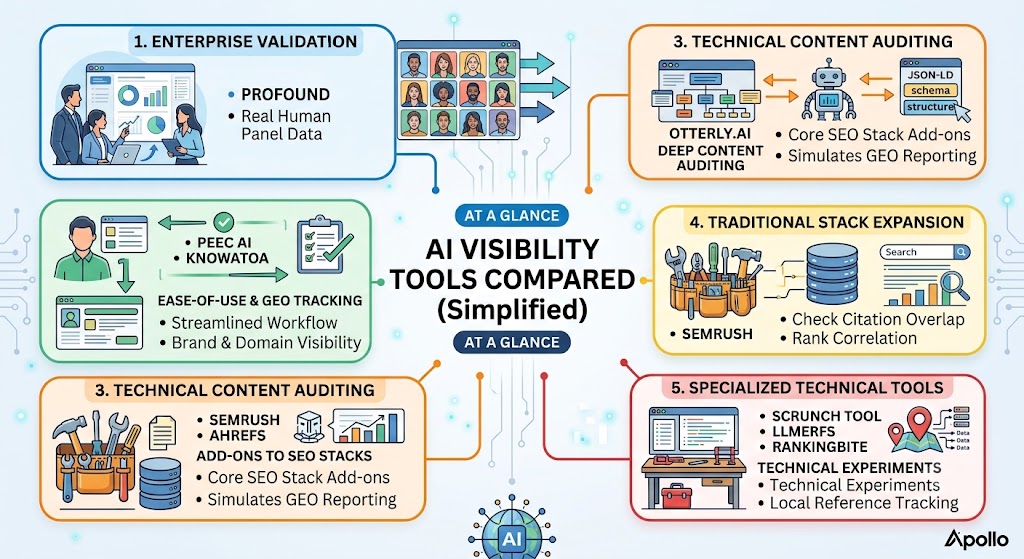
| Tool | Best For | Entry Price | Prompts at Entry | Engines at Entry | Notable | Limitation |
|---|---|---|---|---|---|---|
| Profound | Enterprise, dedicated analysts | ~$499/mo historically; enterprise runs $2,000–5,000+/mo | High volume | Broad, incl. Claude & Gemini | Deepest platform in the category. Conversation Explorer, API, SOC 2, long retention, multi-country support. Raised a $96M Series C and reached an estimated ~$1B valuation in 2026. | Built for analyst teams. Reporting-focused rather than action-focused. Entry pricing varies by source and should be verified. |
| Peec AI | Mid-market, agencies, global brands | ~€89–95/mo; Pro €199/mo | 100 (Pro) | 4 | Unlimited countries and languages on every plan. | Claude, Gemini, and AI Mode require enterprise plans. No content optimization or site audit features. |
| Scrunch AI | Mid-market teams acting weekly | ~$250–300/mo (Core) | 125 | 4 (ChatGPT, Perplexity, Google AIO, Copilot) | Persona & customer journey modeling, real-time alerts, SOC 2 Type II, SSO. | Higher price than many rivals with the same engine count. Refreshes roughly every three days. |
| Otterly.AI | Small businesses & agencies | $29/mo (Lite); $189 Standard; $489 Premium | 15 (Lite); 100 (Standard) | 4 | Looker Studio integration, unlimited workspaces, white-label agency program. | Gemini and AI Mode require paid add-ons ($9–149/mo). Lite plan’s 15 prompts are suitable only for testing. |
| Knowatoa | Small teams & content marketers | $59/mo (Starter); $199/mo (Growth) | 30 (Starter); 100 (Growth) | 3 (Starter); 7 (Growth) | Daily refreshes, CSV/API export on Growth plan, free audit. | Claude, Gemini, and Perplexity are only available on the $199 Growth tier. Monitoring only. |
| LLMrefs | Lean teams seeking value | $79/mo | 500 | Multiple | Excellent prompt allowance for the price. | Analytics are less comprehensive than larger competitors. |
| Semrush AI Toolkit | Existing Semrush customers | ~$99/mo per domain | Varies | Multiple | Convenient if already paying for Semrush. | Less specialized than dedicated AI visibility platforms. Per-domain pricing can become expensive. |
| Ahrefs Brand Radar | Existing Ahrefs customers | ~$828+/mo total | Varies | Multiple | Built on Ahrefs’ established search data infrastructure. | Requires an Ahrefs subscription before Brand Radar access. |
What AI Visibility Tracking Tools Measure
Underneath the branding, every platform does the same four things. The differences are in rigor, coverage, and what happens next.
1. Prompt execution-The tool runs prompts against each engine, repeatedly, on a schedule. This is the raw material, and it’s where the biggest quality gaps hide: how many prompts, how many runs each, via API or the real interface, against which pinned model versions.
2. Response parsing- Each answer is scanned for your brand, your competitors, your URLs. The critical distinction which weaker tools collapse is between two different events:
- Brand mention your name appears in the answer text. Reflects what the model associates with the topic.
- Source citation your URL is cited as a source. Reflects what the retrieval layer fetched and trusted at that moment.
The gap between them is diagnostic. High mentions, low citations: you have category recognition but your pages aren’t being retrieved usually a content-structure or accessibility problem, often fixable in weeks. Low mentions, high citations: your content is quotable but your brand isn’t associated with the category a slower entity and authority problem. A tool reporting one blended “visibility” figure has discarded that diagnosis before you saw it.
3. Classification-Placement and sentiment get scored. Sentiment is where methodology matters most and disclosure is thinnest.
4. Aggregation and trending- Results roll up per engine, per topic, per competitor, over time. Where most tools are competent and where nearly all are tempted to blend engines into a score they shouldn’t.
What no tool can measure, at any price: what any individual real user was shown, what a model “thinks” of you, or whether an AI answer produced a sale. Every number is a sample of prompts you chose, on dates you chose. Exports are windows, not records.
One large citation-mapping study found that roughly 82% of AI citations trace back to earned media third-party coverage, reviews, press rather than to a brand’s own owned content. That’s a direct explanation for the “high mentions, low citations” pattern above: if the model is pulling from someone else’s page to support a claim about you, your own site can be immaculate and still show a thin citation count.
Who Should Use an AI Visibility Tracking Tool?
Most guides answer this with “everyone, urgently.” Here’s the version that will save some readers money.
Buy one if:
- AI already influences your category’s buying decisions. Considered purchases, B2B software, professional services, healthcare, financial products. If your customers ask an assistant “which X should I use,” you’re in.
- Someone will act on the findings. This is the real qualifier. The output is a list of gaps. If nobody will write content, fix entity data, or chase coverage, you’re buying a dashboard, not an outcome.
- You already invest in content or SEO. Then this is instrumentation for spend you’re making anyway the strongest case in the category.
- Competitors are visible and you’re not. Measurable, specific, fixable.
- You need to defend a reputation. If AI describes you with caveats traceable to reviews or old coverage, you need to see it before your buyers do.
Wait if:
- You’ve never measured at all. Start with a manual audit: 20 real buyer questions, four engines, a spreadsheet, an afternoon.
- Nobody owns follow-through. Measurement without action is theatre with a monthly invoice.
- Your category is tiny or hyper-local. Ten minutes in a browser each month may genuinely cover it.
- You’re hoping the tool will fix it. None of them do.
Across broad marketer surveys, a large majority often cited around 90%+ say they intend to optimize for AI search, but the share actually doing so consistently lands closer to 40%. That roughly 50-point execution gap is exactly the failure mode the “wait if nobody owns follow-through” advice above is trying to prevent most organizations aren’t behind on awareness, they’re behind on assigning the work.
How to Choose the Right AI Visibility Tracking Tool
Feature grids are the worst way to buy here. You’re actually buying four things: sample size (prompts × runs × engines), engine coverage on the tier you’ll pay for, an action layer or the absence of one, and an exit (your historical data, in a portable form).
Choose based on your business stage – capacity to act, not headcount:
- Pre-program – you’ve never measured. Buy nothing. Twenty buyer questions, four engines, a spreadsheet, an afternoon.
- Early – one person, part-time. Entry tier, $29–$79/month. Expect a smoke test.
- Growth / mid-market -a team acts monthly or weekly. Roughly $79–$300/month.
- Enterprise – dedicated headcount, procurement, compliance review. Entry sits in the several hundreds; real deployments run into thousands per month.
- Agency – the report is the deliverable. Check per-client cost at your real client count.
Match the tool to your primary use case. Write down the one sentence you want answered monthly. If a tool can’t answer it, its other features are irrelevant competitive benchmarking, reputation monitoring, content gap closure, multi-region coverage, product recommendation tracking, or client reporting each need a different feature set, not a longer checklist.
Two jobs the category does not do, whatever the deck says: proving ROI, and fixing the problem.
Balance Budget With Long-Term Value
The unit you’re buying isn’t prompts. It’s responses.
prompts × runs per prompt × engines = responses per cycle
Tiers are advertised in prompts. Runs the multiplier that controls your margin of error are usually invisible and low. Ask directly: how many times is each prompt executed per cycle, per engine?
SparkToro used 60–100 runs per prompt to get stable per-prompt visibility. A 100-prompt library at 60 runs across 5 engines is 30,000 responses per cycle. Entry tiers commonly offer 15-125 prompts at a handful of runs each. That gap isn’t dishonesty it’s the category’s economics but it’s yours to manage.
Historical data is the real switching cost. Trendlines are the only thing here that appreciates, and they don’t port. Compute total cost honestly. The tool is the small number. The person who acts on it is the large one.
Buy the cheapest tool that answers your one sentence, then upgrade on evidence. Not on funding rounds, not on case studies most are self-published not on leaderboards.
Which Tool Is Best for Different Business Needs?
Enterprise brands: Profound is the depth leader for teams with analysts. Conductor is the alternative when execution workflows matter more than raw analytical depth. Both assume headcount.
Agencies: Otterly.AI runs an explicit agency program with white-label reporting and unlimited workspaces. Peec AI is the mid-market alternative and strongest for multi-region clients. LLMrefs is worth a look when margins are tight.
SaaS and B2B companies: Scrunch AI maps well to B2B funnels via journey-stage modeling. Peec AI takes a product-recommendation lens. Profound if you have the team for it.
Small businesses and startups: Start with a manual audit and a spreadsheet. Otterly.AI at $29/mo is the cheapest credible entry; Knowatoa at $59/mo offers a free audit tier to test first.
Content marketing teams: Knowatoa surfaces which URLs AI already cites and which competitors dominate which questions. Scrunch AI adds funnel-stage context. Prioritize source-level citation data most tools under-report it.
A note on our own product: RankingBite sits in the managed-service end of this market measurement plus the content and entity work to act on it. That’s a different purchase from a self-serve subscription, and we’re not the right comparison for most rows above. We’ve left ourselves out of these recommendations deliberately.
Common Mistakes to Avoid When Comparing AI Visibility Tools
- Trusting a ranking position number- City of Hope: 97% presence, first place 35% of the time. Ask every vendor how they reconcile position reporting with the SparkToro findings.
- Comparing tools using only one metric-Compare on citation rate and share of voice and coverage and sentiment and on whether the tool separates mentions from citations at all.
- Ignoring which engines unlock at your tier- Not the engine count the engine count at the price you’ll pay.
- Choosing features you’ll never use- Buy for your workflow with room to grow, not for the longest feature list.
- Overlooking sample size and methodology-A tool that can’t answer “how many prompts, how many runs” is selling you confidence, not data.
- Skipping manual validation before buying- Build 20-30 representative prompts, run them manually across the engines that matter, and check whether the tool’s numbers survive contact with your own spreadsheet.
How to Make the Final Decision
Fishkin’s advice at the end of his research was to make your provider show their math. These questions do that.
On sampling: How many prompts, and how many runs per prompt, per engine, per cycle? What’s the confidence interval on the headline number? What change would you consider meaningful?
On method: Do you report ranking position, and how do you reconcile that with the SparkToro findings? Do you distinguish a brand mention from a source citation? How is sentiment classified which model, which version, validated against what? Who chose the competitors in my Share of Voice denominator?
On mechanics: API or real interface collection? Which model versions, and are they pinned? Is data blended across engines anywhere in the reporting?
On reproducibility: Can I see the raw answer text behind any data point? Can you reproduce last quarter’s number with the same library?
On incentives: Do you also sell the fix? Not disqualifying but it should inform how you read the findings. Including ours.Transparency about uncertainty is a stronger quality signal than confidence.
When manual tracking is enough: fewer than 50-100 prompts, exploratory visibility, small team, monthly reporting. Keep a consistent prompt library, run each prompt several times across engines, and record mentions, citations, competitors, and sentiment in a spreadsheet.
When it’s time to upgrade: hundreds of tracked prompts, multiple brands or markets, regular executive reporting, client-scale reports, manual tracking eating hours weekly.
How We Evaluate AI Visibility Tools
- Sampling rigor – prompts, runs, intervals, and whether the vendor will state a meaningful-change threshold.
- Engine coverage at the real tier -not the marketing tier.
- Measurement quality -mentions separated from citations; sentiment scoped to your brand’s span; position reported as frequency or not at all.
- Reporting and portability – raw answer access, per-engine detail, exports you can leave with.
- Total value – the tool plus the person who acts on it.
Want to know where your brand stands in the citation economy?
We run a free 6-platform AI visibility audit during a 30-minute strategy call. No prep required — we'll scan your category live during the conversation.