AI visibility is not just about how often a brand appears in AI-generated answers. The difference between being mentioned and being cited determines whether AI recognizes your brand as a trusted reference or simply includes it in a response.
A citation shows that AI used your content as supporting evidence, while a mention only indicates brand visibility. Understanding this difference helps marketers measure AI performance more accurately and evaluate whether they are building authority or awareness.
What Is an AI Citation?
An AI citation occurs when an AI-generated response attributes information to a specific source. The AI system uses that source as supporting evidence and creates a connection between the information provided and the original content.
Citations show that AI systems recognize a source as relevant and useful for answering a specific query. They also allow users to trace information back to its origin.
Example:
User query:
“What are the benefits of CRM automation?”
An AI response may reference a company’s research report, guide, or article while explaining CRM automation. In this case, the brand receives a citation because its content supports the answer.
Research on Generative Engine Optimization (GEO) by researchers from Princeton University, Georgia Institute of Technology, and the Allen Institute for AI found that content with stronger authority signals and clearer information structures had a higher likelihood of appearing in AI-generated responses.
What Makes a Citation Valuable?
A citation is valuable because it connects a brand’s content with the information used in an AI-generated answer.
- Attribution: Shows the original source behind the information and connects the brand with specific knowledge
- Source Credibility: Reliable sources with accurate information, expertise, or original research provide stronger support for AI responses.
- User Verification: Allows users to explore the original source and validate the information provided.
- Measurement Accuracy: Helps brands understand whether their content is influencing AI answers or simply appearing in responses.
What Is an AI Mention?
An AI mention occurs when a brand, product, or website appears in an AI-generated response without being directly used as a supporting source.
Example:
User query:
“What are the best project management tools?”
An AI response may mention tools like Asana, ClickUp, or Notion as possible options. These brands gain visibility, but AI may not have used their content or data to generate the response.
Mentions indicate brand recognition and topical relevance, but they do not necessarily show source influence.
Why Mentions Are Still Valuable
Although mentions do not carry the same authority signal as citations, they still provide valuable insights into how AI recognizes a brand. They help measure visibility beyond source attribution.
- Brand awareness helps identify whether AI consistently recognizes a brand within its category or industry.
- Topic association shows the products, services, or concepts that AI commonly connects with a brand.
- Competitive recognition helps compare a brand’s visibility with other brands appearing in similar AI-generated responses.
Citation vs Mention: Key Differences
| Basis | AI Citation | AI Mention |
|---|---|---|
| Connection | Links information to a specific source. | Links a brand to a topic or category. |
| Role | Supports a claim with evidence. | Indicates brand presence. |
| Signal | Reflects source authority. | Reflects brand recognition. |
| Measurement | Tracks content influence. | Tracks visibility frequency. |
| User Value | Helps users verify information. | Helps users discover brands. |
| Content Impact | Shows AI uses information from the brand. | Shows AI recognizes the brand. |
| Strategic Focus | Builds authority and trust. | Builds awareness and visibility. |
Why Conflating Citations and Mentions Inflates AI Visibility
Many AI visibility reports combine citations and mentions into a single measurement, treating every brand appearance as the same signal.
This creates a problem because a mention only shows that a brand appears in a response, while a citation shows that AI uses the brand’s content as supporting evidence.
When both metrics are combined, brands with strong recognition can appear more influential than they actually are. High mention volume may increase visibility scores even when citation volume remains low.
The Visibility Inflation Problem
A combined visibility score measures appearance volume rather than influence quality.
A brand may appear frequently in AI responses because it is well-known or strongly associated with a category. However, frequent appearances do not always indicate that AI relies on the brand’s content when generating answers.
Separating citations and mentions helps brands understand whether their visibility comes from:
- Brand recognition: How often a brand appears in AI conversations.
- Source authority: How often AI uses a brand’s content as supporting information.
Both contribute to AI visibility, but they represent different outcomes.
Why Citation and Mention Create Different Results
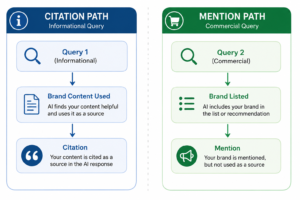
A single brand can receive different types of AI visibility depending on the query. We can look at this with an example
Consider HubSpot.
Query 1: “What is CRM software?”
AI may use HubSpot’s educational content or CRM guides while explaining CRM concepts.
Result: Citation visibility
HubSpot receives a citation because its content supports the information provided.
Query 2: “Best CRM software for startups”
AI may list HubSpot among other CRM platforms based on features, usability, and market presence.
Result: Mention visibility
HubSpot receives a mention because it appears as a relevant option, but its content may not be used as the supporting source.
Both responses include the same brand, but the value differs.
A citation shows AI relies on HubSpot’s information.
A mention shows AI recognizes HubSpot within the CRM category.
How Brands Should Measure Citations and Mentions Separately
Measuring citations and mentions separately provides a more accurate view of AI visibility. Instead of relying on a single visibility score, brands can identify whether AI recognizes their content as a trusted source or simply includes them in responses.
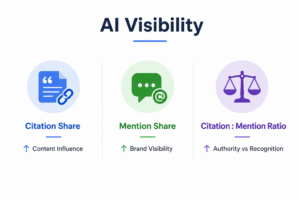
Citation Share
Citation share measures how often a brand’s content is referenced as a source in AI-generated responses.
Formula:
Citations ÷ Total tracked AI responses × 100
A higher citation share indicates stronger content authority and shows that AI frequently relies on the brand’s information when answering user queries.
Mention Share
Mention share measures how often a brand appears in AI responses without being used as a supporting source.
Formula:
Mentions ÷ Total tracked AI responses × 100
A higher mention share indicates stronger brand recognition and category visibility, but it does not necessarily reflect content influence.
Citation to Mention Ratio
The citation to mention ratio compares how much of a brand’s visibility comes from citations versus mentions.
A higher ratio suggests stronger source authority, while a lower ratio indicates that visibility is driven more by brand recognition than content influence.
How to Audit Citation and Mention Performance
A proper AI visibility audit should evaluate the type and quality of brand appearances, not only the number of times a brand appears in AI responses. Since citations and mentions represent different outcomes, separating them helps brands understand whether AI recognizes their content as a source or simply includes their name in the response.
Track Target Queries
Start by analyzing a consistent set of AI queries that reflect different user intents.
Monitor:
- Informational queries – Questions focused on learning or understanding a topic.
- Industry questions – Queries that explore trends, concepts, or category information.
- Product-related searches – Commercial queries where users compare or evaluate solutions.
Classify Brand Appearances
Each appearance should be categorized based on how AI uses the brand within the response.
Classify appearances as:
- Citation – The brand’s content is referenced as a source supporting the answer.
- Mention – The brand appears without being used as supporting evidence.
- Both citation and mention – The brand is referenced and its content also supports the response.
Compare Visibility Patterns
Analyzing citation and mention patterns helps identify the type of AI visibility a brand has.
- High mentions + low citations → Strong brand recognition but limited source influence.
- Low mentions + high citations → Strong content authority but lower category visibility.
- High mentions + high citations → Balanced visibility with both recognition and authority.
Comparing these patterns helps brands identify whether they need to improve awareness, content influence, or both.
How to Improve Citation Visibility Without Chasing Mentions
Improving citation visibility requires focusing on factors that make content valuable as a reference source. The goal is not simply to increase brand appearances, but to create information that AI systems can identify as useful, reliable, and relevant for answering user queries.
Create Original Content
Original research, data, expert insights, and unique perspectives provide stronger reasons for AI systems to reference a source. Content that adds new information is more likely to contribute value beyond general explanations.
Build Topic Authority
Covering related questions, concepts, and industry topics helps establish expertise within a specific category. A broader knowledge base makes it easier for AI systems to connect a brand with relevant information.
Strengthen External Validation
Third-party references, expert mentions, and independent coverage can improve credibility. External validation helps demonstrate that a brand’s information is recognized beyond its own website.
Improve Content Structure
Clear organization, accurate information, and well-defined sections make content easier for AI systems to understand and identify relevant information. Structured content improves the chances of being selected as a useful reference.
Common Mistakes Brands Make When Measuring AI Visibility
Many brands measure AI visibility by counting appearances without considering what those appearances represent. This can lead to inaccurate conclusions about authority and influence.
Treating Every Appearance as Equal
Citations and mentions represent different signals. A citation shows source usage, while a mention only shows brand presence. Combining them equally can overestimate visibility.
Focusing Only on Volume
A higher number of appearances does not always indicate stronger AI influence. The quality and type of appearances matter more than total frequency.
Ignoring Query Context
Different search intents create different visibility opportunities. Informational queries may generate more citations, while commercial queries may produce more mentions.
Using a Single Visibility Score
A combined score can hide whether a brand is gaining recognition or building source authority. Separating metrics provides a clearer understanding of AI performance.
Frequently Asked Questions
-
Can a brand have high AI visibility but low citation visibility?
Yes. A brand may appear frequently through mentions while having limited source influence.
-
Do mentions contribute to AI visibility?
Yes. Mentions show brand recognition, but they do not indicate source authority.
-
Why should citations and mentions be measured separately?
Because citations measure content influence, while mentions measure brand presence.
-
Can a brand improve citations without increasing mentions?
Yes. Stronger content authority can improve citations independently.
-
Are citations always more valuable than mentions?
Not always. Citations measure authority, while mentions measure recognition. Both provide different insights.
Want to know where your brand stands in the citation economy?
We run a free 6-platform AI visibility audit during a 30-minute strategy call. No prep required — we'll scan your category live during the conversation.
Passionate about SEO, AI search, and content marketing, sharing practical insights on search trends, AI visibility, and digital growth.